
Summary: Controlling Japanese Knotweed around the PGST Reservation is essential so it doesn’t grow further out-of-control and disrupt the health of ecosystems that support native plants and fish. The best option is through the use of herbicides that pose very little risk. Crews applying the herbicide are taking every precaution to protect the health and safety of the community as well as neighboring plants. The treatment program will take place on September 14 & 15
If you have questions about Japanese Knotweed, the on-Reservation treatment plan, or what to do if it’s growing in your yard, please contact Megan Richard at merichard@pgst.nsn.us.
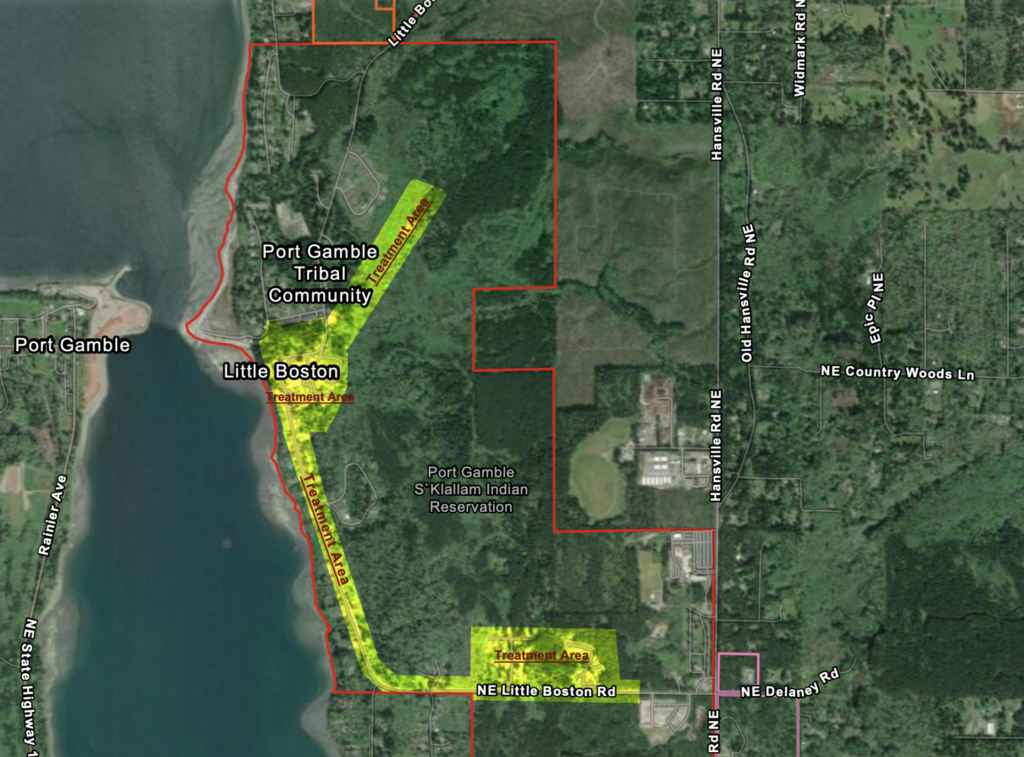
Japanese Knotweed treatment areas
Beginning on September 14, PGST Natural Resources is kicking off a pilot program to handle a growing infestation of Japanese Knotweed, which is spreading in many parts of the Reservation and, if left alone, will grow out of control and harm native plants and waterways. While the treatment includes the use of herbicide, health concerns are limited and Natural Resources and its partners to doing everything possible to ensure the safety of the community.
Japanese Knotweed is a highly invasive plant that, with its jointed stalks and leaves that measure 4 to 6 inches, can be mistaken for bamboo. Growing up to 8-foot tall, plants can continue to spread indefinitely through a lateral root system called rhizomes.
If left untreated, Japanese Knotweed can squeeze out native plants. It also thrives in streams, tributaries, and other small bodies of water. Over time, the plant brings a host of negative consequences, such as reduced stream flow, sediment erosion, reducing aquatic habitat, and increasing mortality for juvenile fish. On the Reservation, Japanese Knotweed can be found adjacent to important watersheds.
Japanese Knotweed cannot be controlled through manual methods like mowing and pulling, as such actions can make infestations worse. For example, shards or fragments of the plant created during mowing can grow into new plants, or even worse, spread by wind or flowing water to a separate area where a new colony of knotweed can establish.
Herbicides are always a last resort by PGST Natural Resources in dealing with invasive plant species. Unfortunately, in the case of Japanese Knotweed, targeted spray and injected herbicides are seemingly the only way to halt, and eventually eradicate, infestations. The coming effort will involve the use of herbicides on plants in areas with heavy growth, including behind the ballfield and along Little Boston Road. A tribal member’s property, which is overrun with the plant, will also be treated.
“We don’t want to use herbicides, and we wouldn’t be if there was another reliable way to deal with the plants,” said Megan Richard, PGST Restoration Project Manager.
Megan and her team at Natural Resources are working with Ecological Restoration & Stormwater Management (ERSM), a company licensed and trained to administer the treatment. Methodology includes cutting off larger plants at the stalk just above the ground to inject herbicide at the base of the stem, while smaller bushes are treated with a targeted spray, taking care to avoid contact with surrounding vegetation.
Treatment areas will be cordoned off with yellow caution tape for up to 48 hours. This is out of an abundance of caution as any sprayed herbicide poses little to no health risk within hours of application. While the contractor is skilled at targeting Japanese Knotweed, there is a chance that surrounding plants might also be impacted.
The community is asked to remain clear of treatment areas while they are blocked off. Please do not pick berries or harvest adjacent plants until the area has been cleared. Outside of the Japanese Knotweed treatment, Natural Resources discourages berry picking or plant harvesting generally along roadways like Little Boston Road.
The Japanese Knotweed treatment plan is a part of a two-year invasive species pilot program by Natural Resources to create an inventory of invasive plants and a species-specific plan for removal. By using a targeted approach, there is a much higher chance of success, but eradication of the knotweed will likely take several years and rounds of treatment.
Megan understands the community’s concerns about herbicides and wishes there were other viable options for dealing with the current infestation. Given the need to control Japanese Knotweed to stave off its worst impacts, herbicides are the recommended path forward.